Roman Empire still going
The New Roman Empire - Interview with Anthony Kaldellis
My comment: The Roman Empire still exists. The Third Rome, Moscow, took over the mantle and the current status, since 1917, is that Tsar Michael II, successor to Tsar Nicholas II tasked the Provisional Government with coming up with a constitutional solution (which would be a revision of the 1906 Constitution (as amended to that point), a task which has not yet been completed by that Government or any of its successors.
Please read my very long comment below.
Maria of Tver died in 1467, and Ivan III decided to marry again to secure his dynasty. His new bride was Sophia (Zoe) Palaiologina (l. c. 1449-1503), the niece of the last Byzantine emperor, Constantine XI (r. 1449-1453).
30/01/2024
Ivan III of Russia - World History Encyclopedia
https://www.worldhistory.org/Ivan_III_of_Russia/
https://en.wikipedia.org/wiki/Sophia_Palaiologina
Sophia Palaiologina
33 languages
Tools hide
General
- What links here
- Related changes
- Special pages
- Permanent link
- Page information
- Cite this page
- Get shortened URL
- Download QR code
- Wikidata item
- Expand all
- Edit interlanguage links
Print/export
In other projects
Appearance hide
Text
-
Small
Standard
Large
Width
-
Standard
Wide
From Wikipedia, the free encyclopedia
This article is about the consort of Ivan III. For the consort of John VIII Palaiologos, see Sophia of Montferrat.
In this name that follows Eastern Slavic naming customs, the patronymic is Fominichna and the family name is Palaiologina.
|
Sophia Palaiologina |
|
|
Reconstruction by Sergey Nikitin, 1994 |
|
|
|
|
|
Tenure |
12 November 1472 – 7 April 1503 |
|
Predecessor |
|
|
Successor |
|
|
|
|
|
Born |
c. 1449 |
|
Died |
7 April 1503 |
|
Burial |
Ascension Convent, Kolomenskoye Archangel Cathedral, Kremlin (1929) |
|
Spouse |
|
|
Dmitri Ivanovich Simeon Ivanovich Feodosiya Ivanovna Eudoxia Ivanovna |
|
|
Father |
|
|
Mother |
|
|
Religion |
Sophia Fominichna Palaiologina or Paleologue (Russian: София Фоминична Палеолог, romanized: Sofiya Fominichna Paleolog; born Zoe Palaiologina; Medieval Greek: Ζωή Παλαιολογίνα; c. 1449 – 7 April 1503) was a Byzantine princess from the Palaiologos imperial dynasty and the grand princess of Moscow as the second wife of Ivan III of Russia.[1] Her father was Thomas Palaiologos, the despot of the Morea. Through her eldest son, Vasili III, she was the grandmother of Ivan IV, the first crowned tsar of all Russia.[2]
Family
Zoe was born in the Morea in 1449. Her father was Thomas Palaiologos, Despot of the Morea and younger brother of the last Byzantine Emperor, Constantine XI Palaiologos (r. 1449–1453).[3] Her mother was Catherine, the only legitimate daughter and heiress of Centurione II Zaccaria, the last independent Prince of Achaea and Baron of Arcadia.
The marriage between Thomas Palaiologos and Catherine Zaccaria produced four children: Helena (later wife of Lazar Branković, Despot of Serbia), Zoe, Andreas, and Manuel.
In Italy
The fall of the Byzantine Empire in 1453 was a turning point in Zoe's life. Seven years later, in 1460, the Ottoman army attacked Morea and quickly breached the Hexamilion wall across the Isthmus of Corinth, which was too long to be effectively manned and defended by Thomas' forces. Thomas and his family escaped to Corfu and then to Rome, where (already recognized as the legitimate heir to the Byzantine Empire by the Pope) he made a ceremonial entrance as Byzantine Emperor on 7 March 1461. Catherine remained in Corfu with her children and died there on 16 August 1462.
Zoe and her brothers remained in Petriti, a fishing port on the southeast coast of Corfu, until 1465, when their dying father recalled them to Rome. Thomas Palaiologos died on 12 May 1465.[4]
Zoe and her brothers were adopted by the Papacy after her father's death. Born and raised in the Orthodox religion, it is possible that she was educated as a Catholic in Rome.[5] She spent the next years in the court of Pope Sixtus IV.
The care of the Imperial children was assigned to a famous Greek humanist, theologian and scholar, Cardinal Basilios Bessarion. The Cardinal's surviving correspondence shows that the Pope took an interest in the welfare and development of Sophia and her brothers. They received 3,600 crowns (in payments of 200 crowns per month) for their clothes, horses and servants, and an additional 100 crowns for the maintenance of a modest household that included a doctor, a Latin teacher, a Greek teacher, a translator, and one or two priests.
After the death of Thomas Palaeologus, his eldest son, Andreas, claimed the Imperial title, but he sold his rights to several European monarchs and ultimately died in poverty. During the reign of Bayezid II, Manuel returned to Constantinople (now Istanbul) and remained there, at the mercy of the Sultan. According to some sources, he converted to Islam, raised a family and served in the Turkish Navy.
In 1466, the Venetian Republic invited King James II of Cyprus to ask for the hand of Sophia in marriage, but he refused. Around 1467, Pope Paul II offered Sophia's hand to a Prince Caracciolo. Although they were solemnly betrothed, the marriage never took place.
Grand Princess consort of Moscow
Maria of Tver, the first wife of Grand Prince Ivan III of Moscow, died in 1467. Their marriage produced one son, Ivan the Young, born in 1458.
The marriage between Sophia and Ivan III was proposed by Pope Paul II in 1469, probably in hopes of strengthening the influence of the Catholic Church in Russia and eventually unifying the Orthodox and Catholic churches, as stipulated in the Council of Florence. Ivan III's motives for pursuing this union were probably related to Sophia's status and her rights over Constantinople. Cardinal Bessarion, a dedicated advocate of reunification, may have conceived the marriage plan.
Negotiations lasted for three years. Russian chronicles describe the events as follows:

Ivan Fryazin showed to Ivan III the portrait of Sophia Palaiologina, by Viktor Muizhel.
- On 11 February 1469, a delegation led by Cardinal Bessarion arrived in Moscow with the formal proposal of a marriage between Sophia and the Grand Prince. Ivan III consulted his mother, Maria of Borovsk, the Metropolitan Philip and his boyars, and received a positive response.
- In 1469, Ivan Fryazin (Gian-Battista della Volpe) was sent to the Papal Court to engage in formal negotiations for the match. The Pope received the Russian Ambassador with great honors. According to the chronicles, Fryazin returned to Moscow with a portrait of the princess that "caused an extreme surprise in the court". (This portrait has not survived. It was probably painted by one of the painters in residence at the Papal Court at that time, either Pietro Perugino, Melozzo da Forlì or Pedro Berruguete).
- On 16 January 1472, Fryazin was sent to Rome again, this time to bring home his master's bride. He arrived in Rome on 23 May, after a journey of more than four months.
- The marriage took place on 1 June 1472, at St. Peter's Basilica. Because Grand Prince Ivan III could not be present, Fryazin served as his proxy. Clarice Orsini (wife of Lorenzo the Magnificent, ruler of Florence) and Queen Catherine of Bosnia were among the guests at the ceremony. [6] Sophia received 6,000 ducats as a dowry.
- On 24 June 1472, Sophia and Fryazin left Rome with a grand entourage. The bride was accompanied by Cardinal Bessarion, who was probably there to act as an agent at the Moscow court. Legend says that Sophia's dowry included books that became the basis of the famous library of Ivan the Terrible, her grandson. Their itinerary took them to the north of Italy and through Germany to the port of Lübeck, where they arrived on 1 September. The voyage across the Baltic Sea took 11 days. The ship landed in Reval (now Tallinn) in October 1472, and she continued the trip through Dorpat (now Tartu), Pskov, and Novgorod. Sophia was officially acclaimed in Pskov, and she impressed onlookers by the way she thanked the public for the celebrations.[5] Sophia finally arrived in Moscow on 12 November 1472.
Even before she departed for Russian lands, it became apparent that the Vatican's plans to have Sophia represent Catholicism had failed: Immediately after her wedding, she returned to the faith of her fathers. Papal Legate Anthony was not permitted to enter Moscow carrying the Latin cross before him.[7] The Korsun cross is on view in the collections of the Moscow Kremlin Museums.
The formal wedding between Ivan III and Sophia took place at the Dormition Cathedral in Moscow on 12 November 1472. Some sources say that the ceremony was performed by Metropolitan Philip, others state that Hosea, Abbot of Kolomna, was the officiant.[8][9]
Special mansions and gardens were built for Sophia in Moscow. They were burned in the great Moscow fire of 1493, and much of the treasure of the Grand Princess was lost.
Sophia was apparently not obliged to follow the custom of isolation[10] that was practiced by elite Russian women among the wealthy boyars and the royal family. It was noted that she did not confine herself to the terems, the women's quarters, but greeted foreign representatives as the queens of Western Europe did.[5]
The Venetian ambassador, Ambrogio Contarini, wrote that in 1476 he had an audience with the Grand Duchess, who received him politely and kindly, and respectfully asked about the Doge.
Before the invasion of Akhmad in 1480, Sophia, her children, household and treasury were sent away, first to Dmitrov and then on to Belozersk. For fear Akhmad would finally take Moscow, she was advised to flee farther north, to the sea. These precautions led Vissarion, Bishop of Rostov, to warn the Grand Duke that his excessive attachment to his wife and children would be his destruction.[11] The family did not return to Moscow until the winter.
Dynastic problems and rivalry
Over time, the second marriage of the Grand Prince became one of the main sources of tension in the court, thanks to the "shrewd" character of the new Grand Princess[5] and the spreading rumours that her husband let himself be directed by her suggestions.[5] It is believed that Sophia introduced grand Byzantine ceremonies and meticulous court etiquette into the Kremlin, pleased with the idea of Moscow as a Third Rome.
In 1472, she was repelled by the formal tributary gesture with which her spouse greeted the Mongolian representatives. She is supposed to have convinced him to abandon that subordinate relationship with the Mongols in a break that was eventually completed in 1480.[5]
Soon, the court divided into two parties. One supported the heir to the throne, Ivan the Young, and the other sided with Sophia. In 1476, the Venetian Ambrogio Contarini noted that the heir to the throne had lost his father's favor, thanks to the intrigues of the Despoina. Despoina, or “Lady”, was used as a Byzantine court title. Sophia was so honoured as her father's heir. However, if any tension existed between father and son, it did not interfere with his rights: From 1477 Ivan the Young was officially referred to as the co-ruler of Ivan III.
The princely family increased significantly: between 1474 and 1490, as the Grand Princess gave birth to eleven children, five sons and six daughters.
There is a legend associated with the birth of Sophia's eldest son, the future Vasily III: During one of her devout visits to the Trinity Lavra of St. Sergius, the Grand Princess had a vision of the Venerable Sergius of Radonezh in which the saint "presented her the long-waited son between his arms."
Another source of tension appeared in the Russian court in January 1483, when Ivan the Young married Elena, daughter of Stephen III the Great, Prince of Moldavia. The heir's new wife soon became involved in court intrigues, especially after 10 October 1483, when she gave birth to a son, Dmitry. After the annexation of Tver in 1485, the Grand Duke named Ivan the Young Grand Prince of this domain. During the 1480s, Ivan's position as the rightful heir was quite secure and Sophia's supporters became less so. In particular, the Grand Princess was unable to obtain government posts for her relatives: Her brother, Andreas, departed from Moscow with nothing, and her niece, Maria (wife of Vasily Mikhailovich, Hereditary Prince of Verey-Belozersky), was forced to flee to Lithuania with her husband, an event that further undermined Sophia's position at court. According to sources, Sophia had arranged her niece's marriage to Prince Vasily in 1480, and in 1483 she gave Maria some jewelry that belonged to Ivan III's first wife. When Ivan the Young asked for these jewels (he wanted to give them to his wife, Elena, as a gift), he discovered they were missing. Outraged, he ordered a search. Prince Vasily did not wait for retribution, but fled to Lithuania with his wife. One direct consequence of this episode was that Prince Michael of Verey-Belozersky, Vasily's father, bequeathed his domains to the Grand Prince, effectively disinheriting his son.[12][13] Sophia was able to obtain a pardon for her niece and her husband in 1493, but they never returned.
New factors came into play around 1490 when Ivan the Young became ill. The diagnosis was gout. Sophia wrote to a Venetian doctor named Leon, who imprudently promised Ivan III that he could cure the heir to the throne. All efforts failed. Ivan the Young died on 7 March 1490, and the doctor was executed.[14] Rumors spread through Moscow that Sophia had poisoned the heir. Andrey Kurbsky, who wrote about these events almost 100 years later, said that these rumors were indisputable facts. However, modern historians say that, due to lack of sources, the theory that Sophia poisoned Ivan the Young cannot be verified.
In 1497, Sophia and her eldest son, Vasili, were allegedly involved in a plot to kill Prince Dmitry, son of Ivan the Young. Both were disgraced and probably banished from court.[15] On 4 February 1498, in the Dormition Cathedral in an atmosphere of great splendor, Prince Dmitry was crowned Grand Prince and co-ruler with his grandfather. Sophia and her son Vasili were not invited to the coronation. However, they were restored to favor in mid-1499 and allowed to return to court.
On 11 April 1502, the dynastic struggle came to an end. According to chronicles, Ivan III suddenly changed his mind and imprisoned both Grand Prince Dmitry and his mother, Elena, placing them under house arrest, surrounded by guards. Three days later, on 14 April, Vasili was crowned the new Grand Prince and co-ruler. Soon, Dmitry and his mother were transferred from house arrest to prison.
The downfall of Dmitry and Elena also determined the fate of the Moscow-Novgorod Reformation movement in the Orthodox Church.[16] In 1503, a council finally defeated it, and many prominent and progressive leaders of the movement were executed. Elena of Moldavia died in prison on 18 January 1505. Her son Dmitry died a few years later, on 14 February 1509, either from hunger and cold, or, as some claim, by suffocation on the orders of his uncle.[17]
Death

Destruction of Sophia Palaiologina grave in 1929.
The triumph of her son was the last important event in Sophia's life. She died on 7 April 1503, two years before her husband, who died on 27 October 1505.
She was buried in a massive white stone sarcophagus in the crypt of the Ascension Convent in the Kremlin, next to the grave of Maria of Tver, the first wife of Ivan III. The word "Sophia" is carved on the lid of the sarcophagus.
The Ascension Convent was demolished in 1929 as ordered by the Soviet government, and the remains of Sophia and of other royal women were transferred to an underground chamber in the southern extension of the Cathedral of the Archangel.
Within decades after the capture of Constantinople by Mehmed II of the Ottoman Empire on 29 May 1453, some Eastern Orthodox people were nominating Moscow as the "Third Rome", or the "New Rome".
https://en.wikipedia.org/wiki/Moscow,_third_Rome
Moscow, third Rome (Russian: Москва, третий Рим; Moskva, tretiĭ Rim) is a theological and political concept asserting Moscow as the successor to ancient Rome, with the Russian world carrying forward the legacy of the Roman Empire. The term "third Rome" refers to a historical topic of debate in European culture: the question of the successor city to the "first Rome" (Rome, within the Western Roman Empire) and the "second Rome" (Constantinople, within the Eastern Roman Empire).
Concept
See also: Holy Rus; Orthodoxy, Autocracy, and Nationality; and Russian world
See also: Church reform of Peter the Great
"Moscow, Third Rome" is a theological and a political concept which was formulated in the 15th–16th centuries in the Tsardom of Russia.[1][unreliable source?]
In this concept, three interrelated and interpenetrating fields of ideas can be found:
that is linked with justification of necessity and inevitability of the unity of the Eastern Orthodox Church.
derived out of the feeling of unity in East Slavic territories being historically tied through Christian Eastern Orthodox faith and Slavic culture.
State doctrine
according to which the Moscow Prince should act as a supreme ruler (Sovereign and legislator) of Christian Eastern Orthodox nations and become a defender of the Christian Eastern Orthodox Church. Herewith the Church should facilitate the Sovereign in execution of his function supposedly determined by God, the autocratic administration.[1]
History
See also: The Tale of the Princes of Vladimir, The Legend of the White Cowl, and Holy Rus
See also: 15th-16th century Moscow–Constantinople schism § Role of the Byzantine emperor in the Eastern Orthodox Church, East–West Schism § Other points of conflict, and State church of the Roman Empire § End of the Western Roman Empire
Before the fall of Constantinople
After the fall of Tǎrnovo to the Ottoman Turks in 1393, a number of Bulgarian clergymen sought shelter in the Russian lands and transferred the idea of the Third Rome there, which eventually resurfaced in Tver, during the reign of Boris of Tver, when the monk Foma (Thomas) of Tver had written The Eulogy of the Pious Grand Prince Boris Alexandrovich in 1453.[2][3]
After the fall of Constantinople

Symbol of the Palaiologos dynasty, the last reigning dynasty of the Byzantine Empire
Within decades after the capture of Constantinople by Mehmed II of the Ottoman Empire on 29 May 1453, some Eastern Orthodox people were nominating Moscow as the "Third Rome", or the "New Rome".[4]
The Turks captured Constantinople in 1453 and the fortress of Mangup – the last fragment of the Empire of Trebizond and thus the Byzantine Empire – fell at the end of 1475. Even before the fall of Constantinople, the Eastern Orthodox Slavic states in the Balkans had fallen under Turkish rule. The fall of Constantinople caused tremendous fears, many considered the fall of Constantinople as a sign the End time was near (in 1492 it was 7000 Anno Mundi); others believed that the emperor of the Holy Roman Empire (although he was a Roman Catholic) now took the place of the emperors of Constantinople. There were also hopes that Constantinople would be liberated soon. Moreover, the Eastern Orthodox Church was left without its Eastern Orthodox Basileus. Therefore, the question arose of who would become the new basileus. At the end of the various "Tales" about the fall of Constantinople, which gained great popularity in Moscow, it was directly stated that the Rus' people would defeat the Ishmaelites (Muslims) and their king would become the basileus in the City of Seven Hills (Constantinople). The Grand Prince of Moscow remained the strongest of the Eastern Orthodox rulers; Ivan III married Sophia Paleologue, broke his formal subordination to the Golden Horde (already divided into several Tatar kingdoms) and became an independent ruler. All of this strengthened Moscow's claims to primacy in the Eastern Orthodox world. However, the liberation of Constantinople was still far away — the Moscow State had no opportunity to fight the Ottoman Empire.[5]
End of the 15th century
At the end of the 15th century, the emergence of the idea that Moscow is truly a new Rome can be found;[5] the whole idea of Moscow as third Rome could be traced as early as 1492, when Metropolitan of Moscow Zosimus expressed it. Metropolitan Zosima, in a foreword to his work of 1492 Presentation of the Paschalion (Russian: "Изложение пасхалии"),[1] quite clearly expressed it, calling Ivan III "the new Tsar Constantine of the new city of Constantine — Moscow."[5][6] This idea is best known in the presentation of the monk Philotheus of the early 16th century:[7][8][9]
So know, pious king, that all the Christian kingdoms came to an end and came together in a single kingdom of yours, two Romes have fallen, the third stands, and there will be no fourth [emphasis added]. No one shall replace your Christian Tsardom according to the great Theologian [cf. Revelation 17:10] [...].
The Moscow scholars explained the fall of Constantinople as the divine punishment for the sin of the Union with the Catholic Church, but they did not want to obey the Patriarch of Constantinople, although there were no unionist patriarchs since the Turkish conquest in 1453 and the first Patriarch since then, Gennadius Scholarius, was the leader of the anti-unionists. At the next synod, held in Constantinople in 1484, the Union was finally declared invalid. Having lost its Christian basileus after the Turkish conquest, Constantinople as a center of power lost a significant part of its authority. On the contrary, the Moscow rulers soon began to consider themselves real Tsars (this title was already used by Ivan III), and therefore according to them the center of the Eastern Orthodox Church should have been located in Moscow, and thus the bishop of Moscow should become the head of the Orthodoxy.[5] The text of the bishop's oath in Muscovy, edited in 1505–1511, condemned the ordination of metropolitans in Constantinople, calling it "the ordination in the area of godless Turks, by the pagan[a] tsar."[10]
Stirrings of this sentiment began during the reign of Ivan III of Russia, who styled himself Czar (cf. Caesar), who had married Sophia Paleologue. Sophia was a niece of Constantine XI, the last Byzantine emperor. By the rules and laws of inheritance followed by most European monarchies of the time, Ivan could claim that he and his offspring were heirs of the fallen Empire, but the Roman traditions of the empire had never recognized automatic inheritance of the Imperial office.[11]
Since the 16th century
See also: Church reform of Peter the Great
It was also Sophia's brother, Andreas Palaiologos, who held the rights of succession to the Byzantine throne. Andreas died in 1502, having sold his titles and royal and imperial rights to Ferdinand II of Aragon and Isabella I of Castile, who would not act on them. A stronger claim was based on religious symbolism. The Orthodox faith was central to Byzantine notions of their identity and what distinguished them from "barbarians". As the preeminent Orthodox nation following the Byzantine collapse, Moscow would view itself as the empire's logical successor:
"The liturgical privileges that the Byzantine emperor enjoyed carried over to the Muscovite tsar. In 1547, for instance, when Ivan IV was crowned tsar, not only was he anointed as the Byzantine emperor had been after the late twelfth century, but he was also allowed to communicate in the sanctuary with the clergy."[12]
During Ecumenical Patriarch Jeremias II's visit to Moscow in 1588-9 "to collect funds to assist the [Eastern] Orthodox communities living in the Ottoman Empire",[13] Jeremias recognized in 1589 the Metropolitan of Moscow as patriarch.[14] This recognition was "a victory for those who saw Moscow as the Third Rome."[13]
Shortly before Joseph II inherited the States of the House of Austria, he traveled to Russia in 1780. In her conversations with him, Catherine II made it clear that she would renew the Byzantine empire and to use her one-year-old grandson Konstantin as Emperor of Constantinople. The guest tried to suggest to the host that he could be held harmless in the Papal States.[15]
Russian world
See also: Russian world
The Russian world is ecclesiastical in its form, but geopolitical in its essence; it is a concept that was put forward in a keynote speech on November 3, 2009, by Patriarch Kirill (Gundyayev) of Moscow which he described as a "common civilisational space" of countries sharing Eastern Orthodoxy, Russian culture and language, and a common historical memory.[16][17] The "Russian world" under the Patriarch Kirill focused only on the Eastern Slavic countries of Eastern Europe; that is, on Ukraine and Belarus, while leading the Russian Orthodox Church to isolate itself.[18]
The ideas of the Russian world are used as a justification for the revival of the Russian Empire.[19] It has been suggested that Vladimir Putin envisions a recreation of Russia's "mission", at least in terms of the Slavic people,[20] although it has also been noted that this viewpoint may be highly exaggerated.[21]
https://en.wikipedia.org/wiki/House_of_Romanov
Downfall

The Romanovs visiting a regiment during World War I. From left to right, Grand Duchess Anastasia, Grand Duchess Olga, Tsar Nicholas II, Tsarevich Alexei, Grand Duchess Tatiana, and Grand Duchess Maria, and Kuban Cossacks
The February Revolution of 1917 resulted in the abdication of Nicholas II in favor of his brother Grand Duke Michael Alexandrovich.[1] The latter declined to accept imperial authority save to delegate it to the Provisional Government pending a future democratic referendum, effectively terminating the Romanov dynasty's rule over Russia.
https://en.wikipedia.org/wiki/Grand_Duke_Michael_Alexandrovich_of_Russia
Abdication of Nicholas II
On the afternoon of 15 March [O.S. 2 March] 1917, Emperor Nicholas II, under pressure from generals and Duma representatives, abdicated in favour of his son, Alexei, with Michael as Regent.[105] Later that evening, though, he reconsidered his decision. Alexei was gravely ill with haemophilia and Nicholas feared that if Alexei was emperor, he would be separated from his parents.[106] In a second abdication document, signed at 11.40 p.m. but marked as having been issued at 3.00 p.m., the time of the earlier one,[107] Nicholas II declared:
We have judged it right to abdicate the Throne of the Russian State and to lay down the Supreme Power. Not wishing to be parted from Our Beloved Son, We hand over Our Succession to Our Brother the Grand Duke Michael Aleksandrovich and Bless Him on his accession to the Throne.[108]

Prince Lvov, Prime Minister of Russia, March–July 1917
By early morning, Michael was proclaimed as "Emperor Michael II" to Russian troops and in cities throughout Russia, but his accession was not universally welcomed. While some units cheered and swore allegiance to the new emperor, others remained indifferent.[109] The newly formed Provisional Government had not agreed to Michael's succession.[110] When Michael awoke that morning, he discovered not only that his brother had abdicated in his favour, as Nicholas had not informed him previously, but also that a delegation from the Duma would visit him at Putyatina's apartment in a few hours' time.[111] The meeting with Duma President Rodzianko, the new Prime Minister Prince Lvov and other ministers, including Pavel Milyukov and Alexander Kerensky, lasted all morning.[112] Putyatina laid on a lunch, and in the afternoon two lawyers (Baron Nolde and Vladimir Nabokov) were called to the apartment to draft a manifesto for Michael to sign. The legal position was complicated, as the legitimacy of the government, whether Nicholas had the right to remove his son from the succession, and whether Michael actually was emperor, were all open to question.[113] After further discussion, and several drafts, the meeting settled on a declaration of conditional acceptance as an appropriate form of words.[114] In it, Michael deferred to the will of the people and acknowledged the Provisional Government as the de facto executive, but neither abdicated nor refused to accept the throne.[115] He wrote:
Inspired, in common with the whole people, by the belief that the welfare of our country must be set above everything else, I have taken the firm decision to assume the supreme power only if and when our great people, having elected by universal suffrage a Constituent Assembly to determine the form of government and lay down the fundamental law of the new Russian State, invest me with such power.
Calling upon them the blessing of God, I therefore request all the citizens of the Russian Empire to submit to the Provisional Government, established and invested with full authority by the Duma, until such time as the Constituent Assembly, elected within the shortest possible time by universal, direct, equal and secret suffrage, shall manifest the will of the people by deciding upon the new form of government.[116]
Commentators, ranging from Kerensky to French ambassador Maurice Paléologue, regarded Michael's action as noble and patriotic,[117] but Nicholas was appalled that Michael had "kowtowed to the Constituent Assembly" and called the manifesto "rubbish".[118]
The hopes of the monarchists that Michael might be able to assume the throne following the election of the Constituent Assembly were overtaken by events. His renunciation of the throne, though conditional, marked the end of the Tsarist regime in Russia. The Provisional Government had little effective power; real power was held by the Petrograd Soviet.[119]
Arrest

Alexander Kerensky, Prime Minister of Russia from July to October 1917
Michael returned to Gatchina and was not permitted to return to his unit or to travel beyond the Petrograd area. On 5 April 1917, he was discharged from military service.[120] By July, Prince Lvov had resigned as Prime Minister to be replaced by Alexander Kerensky, who ordered ex-Emperor Nicholas removed from Petrograd to Tobolsk in the Urals because it was "some remote place, some quiet corner, where they would attract less attention".[121] On the eve of Nicholas's departure, Kerensky gave permission for Michael to visit him. Kerensky remained present during the meeting and the brothers exchanged awkward pleasantries "fidgeting all the while, and sometimes one would take hold of the other's hand or the buttons of his uniform".[121] It was the last time they saw each other.
On 21 August 1917, guards surrounded the villa on Nikolaevskaya street where Michael was living with Natalia. On the orders of Kerensky, they were both under house arrest, along with Nicholas Johnson, who had been Michael's secretary since December 1912.[122] A week later, they were moved to an apartment in Petrograd.[123] Michael's stomach problems worsened and, with the intervention of British ambassador Buchanan and foreign minister Mikhail Tereshchenko, they were moved back to Gatchina in the first week of September.[124] Tereshchenko told Buchanan that the Dowager Empress would be allowed to leave the country, for Britain if she wished, and that Michael would follow in due course.[125] The British, however, were not prepared to accept any Russian Grand Duke for fear it would provoke a negative public reaction in Britain, where there was little sympathy for the Romanovs.[126]
On 1 September 1917, Kerensky declared Russia a republic. Michael wrote in his diary: "We woke up this morning to hear Russia declared a Republic. What does it matter which form the government will be as long as there is order and justice?"[127] Two weeks later, Michael's house arrest was lifted.[128] Kerensky had armed the Bolsheviks after a power struggle with the commander-in-chief and in October there was a second revolution as the Bolsheviks seized power from Kerensky. With a permit to travel issued by Peter Polotsov, a former colleague of Michael from the Savage Division who was now a commander in Petrograd, Michael planned to move his family to the greater safety of Finland.[129] They packed valuables and prepared to move, but their preparations were seen by Bolshevik sympathisers and they were placed once more under house arrest.[130] The last of Michael's cars were seized by the Bolsheviks.[131]
The house arrest was lifted again in November, and the Constituent Assembly was elected and met in January 1918. Despite being the minority party, the Bolsheviks dissolved it.[132] On 3 March 1918 (N.S.), the Bolshevik government signed the Treaty of Brest-Litovsk, which effectively ceded vast areas of the former Russian Empire to the Central Powers of Germany, Austria-Hungary and the Ottoman Empire. On 7 March 1918, Michael and his secretary Johnson were re-arrested on the orders of Moisei Uritsky, the Head of the Petrograd secret police, and imprisoned at the Bolshevik headquarters in the Smolny Institute.[133]
Imprisonment
On 11 March 1918, Uritsky sent Michael and Johnson to Perm, a thousand miles to the east, on the order of the Council of the People's Commissars, which included both Vladimir Lenin and Joseph Stalin.[134] The journey, by freight train in a coach without windows or heat, took eight days at an average speed of 5 miles per hour.[135] At first, Michael was billeted in a hotel but two days after his arrival he was jailed by the local Soviet.[136] Natalia lobbied the Commissars in Petrograd for his release and, on 9 April 1918, he was set at liberty within Perm.[137] He moved into the best room in the best hotel in Perm, along with Johnson and two manservants, valet Vasily Chelyshev and former chauffeur Borunov.[138] Natalia feared for George's safety, and in March 1918, she arranged for him to be smuggled out of Russia by his governess, Margaret Neame, with the help of Danish diplomats and the Putyatins.[139]
In May, Natalia was granted a travel permit to join Michael. Accompanied by family friends Prince Putyatin and Margaret Abakanovich, she arrived at Perm before the Orthodox Easter and they spent about a week together.[140] Meanwhile, as part of the truce between the Bolsheviks and the Central Powers, prisoners-of-war from Austria-Hungary were being shipped out of Russia. Czech troops were strung out along the Trans-Siberian Railway on their way to Vladivostok, where they were due to take ship. The Czechs, though, were not going home to fight for the Austrian empire but to fight for a separate homeland independent of Austria. The Germans demanded that the Bolsheviks disarm the Czechs, who fought back, seized the railway, joined forces with Russians fighting against the Bolsheviks and advanced westwards toward Perm.[141] With the approach of the Czechs, Michael and Natalia feared that she would become trapped there, possibly in a dangerous situation and so, on 18 May, she left unhappily.[142] By early June, Michael was again ill with stomach trouble.[143]
Death

Michael (left) with Johnson in Perm, April 1918
On 12 June 1918, the leader of the local secret police, Gavril Myasnikov,[144] with the connivance of other local Bolsheviks,[145] hatched a plan to murder Michael. Myasnikov assembled a team of four men who, like him, were all former prisoners of the Tsarist regime: Vasily Ivanchenko, Ivan Kolpashchikov, Andrei Markov and Nikolai Zhuzhgov.[146] Using a forged order, the four men gained entry to Michael's hotel at 11.45 p.m.[147] At first, Michael refused to accompany the men until he spoke with the local chairman of the secret police, Pavel Malkov, and then because he was ill. His protestations were futile and he got dressed. Johnson insisted on accompanying him and the four men plus their two prisoners climbed into two horse-drawn three-seater traps.[148]
They drove out of the town into the forest near Motovilikha. When Michael queried their destination, he was told they were going to a remote railway crossing to catch a train.[149] By now it was the early hours of 13 June. They all alighted from the carriages in the middle of the wood, and both Michael and Johnson were fired upon, once each, but as the assassins were using home-made bullets, their guns jammed. Michael, who may or may not have been injured, moved towards the wounded Johnson with arms outstretched, when he was shot at point-blank range in the head.[150] Both Zhuzhgov and Markov claimed to have fired the fatal shot.[150] Johnson was shot dead by Ivanchenko.[151]
The bodies were stripped and buried. Anything of value was stolen and the clothes were taken back to Perm. After they were shown to Myasnikov as proof of the murders, the clothes were burned.[152] The Ural Regional Soviet, headed by Alexander Beloborodov, approved the killing, either retrospectively or beforehand,[153] as did Lenin.[154] Michael was the first of the Romanovs to be killed by the Bolsheviks, but he was not the last.[155] Neither Michael's nor Johnson's remains have been found.[156]
The Perm authorities distributed a concocted cover story that Michael was abducted by unidentified men and had disappeared.[156] Chelyshev and Borunov were arrested. Shortly before his own arrest, Colonel Peter Znamerovsky, a former Imperial army officer also exiled to Perm, managed to send Natalia a brief telegram saying that Michael had disappeared. Znamerovsky, Chelyshev and Borunov were all killed by the Perm Bolsheviks.[153] Soviet disinformation about Michael's disappearance led to unfounded rumours that he had escaped and was leading a successful counter-revolution.[157] In the ultimately forlorn hope that Michael would ally with Germany, the Germans arranged for Natalia and her daughter to escape to Kiev in German-controlled Ukraine. On the collapse of the Germans in November 1918, Natalia fled to the coast, and she and her daughter were evacuated by the British Royal Navy.[158]
On 8 June 2009, four days short of the 91st anniversary of their deaths, both Michael and Johnson were officially rehabilitated. Russian State Prosecutors stated, "The analysis of the archive material shows that these individuals were subject to repression through arrest, exile and scrutiny ... without being charged of committing concrete class and social-related crimes."[159]
Michael's son George, Count Brasov, died in a car crash shortly before his 21st birthday in 1931.[160] Natalia died penniless in a Parisian charity hospital in 1952.[161] His stepdaughter Natalia Mamontova married three times and wrote a book about her life entitled Step-Daughter of Imperial Russia, published in 1940.[162]
https://imperialhouse.ru/en/imperialhouse-en/succession/385.html
Dynastic Succession
The Russian Imperial House: A Historical Survey
The Imperial House of Russia is the Romanoff Dynasty, which ruled until 1917 and was elevated to the throne by the Assembly of the Land (Zemskii Sobor) in 1613 because of its close kinship ties through the female line with the extinct Riurikovich Dynasty. The direct male line of the Romanoff Dynasty ended in 1730 (on the death of Emperor, Peter II, the grandson of Peter I “the Great”). After that, the Russian Throne was occupied by Peter the Great’s niece, Empress Anna Ioannovna (ruled 1730-1740), then by her grandnephew, Emperor Ivan VI Antonovich (ruled 1740-1741), and then by Peter the Great’s daughter, Empress Elizabeth Petrovna (ruled 1741-1762). In 1761, the succession to the throne, together with all the corresponding titles and the surname “Romanoff,” passed through the female line to the House of Holstein-Gottorp (to Peter the Great’s grandson, Peter III Fedorovich, the son of Peter the Great’s daughter, Tsarevna Anna Petrovna). Emperor Paul I, the son of Peter III, issued a Decree on the Imperial Succession on April 5, 1797, which determined the order of succession to the throne, as well as membership in the Russian Imperial House. This Decree was amended on March 20, 1820, by Emperor Alexander I, who issued a Manifesto stipulating that, “if any person in the Imperial Family enters into a marriage with a person of a status unequal to His, that is, not belonging to any Royal or Ruling House, in such a case the person in the Imperial Family cannot pass on to the other person the rights which belong to Members of the Imperial Family, and the children issuing from such a marriage have no right of succession to the throne.”
Russian dynastic law, which was based upon the Decree on the Imperial Succession, belongs to what is known as the Austrian system of succession, which stipulates male primogeniture. In Russia, succession passed through the female line only after the extinction of all male branches of the dynasty. Similar to the succession laws governing other monarchies, the articles pertaining to the succession to the throne (Articles 25-39 of the Fundamental Laws of the Russian Empire) are inviolable—that is, not susceptible to abolition or modification even by the Sovereign Emperor.
According to the definition in the Encyclopedic Dictionary by Brockhaus and Efron, the Russian Imperial House is “a special institution, membership in which is enjoyed by those who may be called upon to inherit the throne according to the established laws, and by those who are married to persons who have or may come to have the right to inherit the throne.”1
Before the Revolution of 1917, the Russian Imperial House of Romanoff was a unique institution: a family that had the status of a state institution, and whose members received the crown according to a prescribed order of succession. After the 1917 Revolution, the Russian Imperial House lost its political power as well as its status as a state institution, but it retained its status as a historical institution, that is—a legal entity that has enjoyed an unchallenged dynastic continuity from the moment of its ascension to the throne, and that operates then and now according to its own internal historical laws.
Just like the Church’s canon laws, the dynastic laws of the Russian Imperial House continue in force to the extent that they do not conflict with the Constitution and other laws of the Russian Federation.
Since the Revolution of 1917, the Russian Imperial House has lived in exile, but the order of succession to the position of Head of the Dynasty and membership in the dynasty have remained firmly governed by the statutes of Russian dynastic laws. Membership in the Russian Imperial House is governed specifically by the relevant articles of the Fundamental Laws of the Russian Empire.
After the abdication on March 2, 1917, of Emperor Nicholas II for Himself and for His Heir, Aleksei Nikolaevich, the succession passed to the Emperor’s brother, Grand Duke Mikhail Alexandrovich. In His Manifesto of March 3, 1917, Grand Duke Mikhail delayed accepting the crown until the Constituent Assembly could meet and decide upon the future form of Russia’s government. On September 1, 1917, before the Constituent Assembly had been called, Alexander Kerensky, the prime minister of the Provisional Government, in violation of prior decrees, declared Russia to be a republic.
In 1918, Grand Duke Mikhail Alexandrovich, the former Emperor Nicholas II, and the Heir and Tsesarevich Aleksei Nikolaevich, that is, the entire male line issuing from Emperor Alexander III, were executed on orders from the godless regime then in power. In accordance with Article 29 of the Law of Succession, the right to the throne passed to the line issuing from Alexander II: to the descendants of Grand Duke Wladimir Alexandrovich (1847-1908). The latter’s eldest son, Grand Duke Kirill Wladimirovich, declared himself in 1922 the curator of the Throne (since He was still not absolutely certain of the death of Emperor Nicholas II, his son, and brother); and on August 31, 1924, he assumed the title of Emperor-in-exile of All the Russias.
This Manifesto was fully consistent with the Fundamental Laws and was recognized by practically all Members of the House of Romanoff, and by foreign Royal Houses. One of the junior lines of the dynasty, composed of Grand Duke Nicholas Nikolaevich, Grand Duke Peter Nikolaevich, and the latter’s son, Prince-of-the-Imperial-Blood Roman Petrovich, did not recognize the Manifesto of August 31, 1924—all of them believing that the question of who occupies the throne should be decided by the will of the people. The elderly Dowager Empress Maria Fedorovna, not disputing the legality of Grand Duke Kirill Wladimirovich’s action, considered his Manifesto “premature,” since she never gave up hope that one of her sons or her grandson might somehow still be alive in Russia.
At the time that Kirill Wladimirovich assumed the Imperial title, there were still 18 male Members of the Russian Imperial House living in immigration. Their order in the succession to the Throne at that time was as follows:
- The lines of descent from Emperor Alexander
- The line of Grand Duke Wladimir Alexandrovich
- Grand Duke Wladimir Kirillovich (son and Heir of Emperor Kirill Wladimirovich)
- Grand Duke Boris Wladimirovich
- Grand Duke Andrei Wladimirovich
- The line of Grand Duke Paul Alexandrovich
- Grand Duke Dmitrii Pavlovich
- The lines of descent from Emperor Nicholas I:
- The line of Grand Duke Constantine Nikolaevich
- Prince Vsevolod Ioannovich (son of Prince Ioann Konstantinovich)
- Prince Gavriil Konstantinovich
- Prince Georgii Konstantinovich
- The line of Grand Duke Nicholas Nikolaevich the Elder
- Grand Duke Nicholas Nikolaevich the Younger
- Grand Duke Peter Nikolaevich
- Prince Roman Petrovich
- The line of Grand Duke Mikhail Nikolaevich
- Grand Duke Mikhail Mikhailovich
- Grand Duke Alexander Mikhailovich
- Prince Andrei Alexandrovich
- Prince Feodor Alexandrovich
- Prince Nikita Alexandrovich
- Prince Dmitrii Alexandrovich
- Prince Rostislav Alexandrovich
- Prince Vasilii Alexandrovich
Given the fact that they were all living in exile, the majority of these members of the Imperial House did not consider themselves to be obligated to follow strictly the requirements of the Fundamental Laws. This is exemplified by the many morganatic (unequal) marriages that occurred after 1917—that is, marriages with persons who do not belong to royal or ruling houses. Grand Dukes and Princes-of-the-Imperial-Blood who had entered into morganatic marriages did not themselves lose their rights to the throne or their membership in the Dynasty, but their descendants, by virtue of Articles 36 and 188 of the Fundamental Laws of the Russian Empire, possessed no dynastic rights whatsoever (neither the right to the throne, nor titles, nor even the dynastic surname “Romanoff”). Rather, a special status for the descendants of these morganatic unions was devised whereby they would be known as princes Romanovskii, along with a hyphenated surname of their choice, provided that the parents had beforehand requested permission to marry from the Head of the Dynasty (Decree of July 28, 1835). The rights to these titles as provided for in the Decree of July 28, 1935, were utilized by Grand Dukes Andriei Wladimirovich and Dmitrii Pavlovich, and by Princes-of-the-Imperial-Blood Vsevolod Ioannovich, Gavriil Konstantinovich, Dmitrii Aleksandrovich, and by the widow of Grand Duke Mikhail Aleksandrovich, Princess N. S. Brasova. The morganatic son of Grand Duke Nicholas Konstantinovich, A. N. Iskander, received the princely title without the addition of “Romanovskii” to his surname. Grand Duke Boris Wladimirovich, Prince Roman Petrovich, and the sons of Grand Duke Alexander Mikhailovich (with the exception of Prince Dmitrii Aleksandrovich) did not seek permission to marry from the Head of the Dynasty and therefore did not receive titles for their spouses or children.
Emperor Kirill Wladimirovich died on October 12, 1938. His son, Grand Duke Wladimir Kirillovich, became the Head of the Dynasty but, following the example of many other Heads of dispossessed foreign dynasties, considered it prudent not to adopt formally the title Emperor until such time as the Monarchy in Russia should be restored. The Decree of his Father had already legally secured the continuing operation of the Fundamental Laws of the Russian Empire in the realm of dynastic law. Grand Duke Wladimir Kirillovich used the official title “Head of the Russian Imperial House, His Imperial Highness, Sovereign, Grand Duke,” which implied the title of Emperor de jure.
Grand Duke Wladimir Kirillovich, was the sole male dynast of the Imperial House to enter into an equal marriage after 1917. On August 13, 1948, he married Grand Duchess Leonida Georgievna, the daughter of the Head of the Georgian Royal House, H.R.H. Prince George Alexandrovich Bagration-Mukhrani. The royal status of the House of Bagration was permanently recognized by Russia in the Treaty of Georgievsk of 1783 and was confirmed by the Decree of December 5, 1946, issued by the Head of the Russian Imperial House at the request of the Royal House of Spain and has been recognized by all the royal houses of Europe.
From this marriage was born on December 23, 1953, Grand Duchess Maria Wladimirovna. Inasmuch as all other living male dynasts of the Imperial family had entered into morganatic marriages, and because their advanced age made it unlikely that any of them would enter into new and equal marriages and, even less likely, have children—the Grand Duchess became the presumptive future Heiress to the throne by virtue of the inviolable Article 30 of the Fundamental Laws of the Russian Empire. Therefore, her father, Grand Duke Wladimir Kirillovich, proclaimed her majority to be 16 years of age (in accordance with Article 40), and, on December 23, 1969, issued a Decree proclaiming that, in the event of the Grand Duke’s death, the Grand Duchess was to be the curatrix over the proper order of succession to the title of Head of the House. This Decree drew objections from certain Princes of the Blood, but its legality cannot be challenged, because it deprived no male dynasts of the Dynasty of any of their legal rights, but merely established oversight over the correct succession.
At the time that the Decree of 1969 was issued, the male line succession after Grand Duke Wladimir Kirillovich would have been the following:
- Prince Vsevolod Ioannovich (1914-1973). His first marriage was to Lady Mary Lygon, a British subject, who was granted the title of Princess Romanovskii-Pavlovskii (1939). His second wife was to Emilia de Gosztonyi of Hungary, a Hungarian, who was granted the title of Princess Romanovskii (1956) by Grand Duke Wladimir Kirillovich. His third wife was Valli Knust, a Dane, to whom Grand Duke Wladimir Kirillovich granted the title of Princess Romanovskii-Knust (1961). No children issued from any of the three marriages.
- Prince Roman Petrovich (1869-1978). His wife was Countess Praskovia Dmitrievna Sheremetev. Children born to this marriage are morganatic: and they have no rights to any dynastic titles.
- Prince Andrei Aleksandrovich (1897-1981). His first wife was Elisaveta Fabrizievna Ruffo. His second wife was Nadine McDougall of Great Britain. Children born to these marriages are morganatic and they have no rights to any dynastic titles.
- Prince Nikita Aleksandrovich (1900-1974). His wife was Countess Maria Ilarionovna Vorontsov-Dashkov. Children born to this marriage are morganatic and have no rights to any dynastic titles. The line descended from Prince Nikita has died out.
- Prince Dmitrii Aleksandrovich (1901-1980). His first wife was Countess Marina Sergievna Golenishchev-Kutuzov, who was granted the title Princess Romanovskii-Kutuzov by Emperor Kirill Wladimirovich. His second wife was Sheila Chisholm of Australia. The daughter born to the first marriage was Princess Nadezhda Romanovskii-Kutuzov. The line of descent from Prince Dmitrii has died out.
- Prince Rostislav Aleksandrovich (1902-1977). His first wife was Princess Alexandra Pavlovna Golitsyn, his second wife was Alice Baker of the United States, and his third wife was Hedwig von Chappuis of Germany. Children born of these marriages are morganatic and have no rights to any dynastic titles.
- Prince Vasilii Aleksandrovich (1907-1989). His wife was Princess Natalia Alekseevna Golitsyn. The marriage produced no male issue. Their lone child, a daughter, is morganatic and has no rights to any dynastic titles.
Male dynasts of the Imperial House who died before 1969—Grand Duke Boris Wladimirovich, Grand Duke Andrei Wladimirovich, Grand Duke Dmitrii Pavlovich, Grand Duke Gavriil Konstantinovich, Grand Duke Mikhail Mikhailovich, Prince Georgii Konstantinovich (who died unmarried), and Prince Feodor Alexandrovich—similarly left no issue who are dynasts, since all of their marriages were morganatic.
With the passing in 1989 of Vasilii Alexandrovich, the last living Prince of the Imperial Blood, which occurred during the lifetime of Grand Duke Wladimir Kirillovich, Grand Duchess Maria Wladimirovna became not only the presumed future Heiress, but in fact the actual Heiress to Her Father’s title.
In 1976, Grand Duchess Maria Wladimirovna entered into an equal marriage with Prince Franz-Wilhelm of Prussia, who, after being received into the Orthodox Church, took the name Mikhail Pavlovich, and was granted the title Grand Duke by his father-in-law, Grand Duke Wladimir Kirillovich. The marriage was later dissolved by divorce; but had the marriage not ended, the position in the dynasty of Grand Duke Mikhail Pavlovich would have been determined by Article 6 of the Fundamental Laws of the Russian Empire, which provides that, if Grand Duchess Maria Wladimirovna had ascended the throne, then her husband would have the same rights of any spouse of a Russian emperor (similar to the position and rights enjoyed by Prince Philip, the Duke of Edinburgh, the husband of Queen II of Great Britain and Northern Ireland.)
On March 13, 1981, a son was born of this marriage: Grand Duke Georgii Mikhailovich. By an agreement made between Grand Duke Wladimir Kirillovich and Prince Louis Ferdinand, the respective Heads of the Russian and German Imperial Houses, Grand Duke Georgii Mikhailovich’s father became a member of the Russian Imperial House, and therefore the newborn child belonged from the time of his birth to the Romanoff Dynasty and bore a Russian title.
On April 21, 1992, the Head of the Russian Imperial House, Grand Duke Wladimir Kirillovich, died. With his death, the male line of the Romanoff Dynasty became extinct, similar to the situation that occurred in 1730. But unlike then, when the succession was determined by the will of one person or by a small group, the succession in 1992 was determined by a clear and precise Law of Succession. Article 30 of the Fundamental Laws of the Russian Empire undisputably assigned the headship of the Russian Imperial House to Grand Duchess Maria Wladimirovna.
At present, the Russian IMPERIAL House consists of two persons:
- The Head of the Russian Imperial House, Her Imperial Highness, Grand Duchess (de jure Empress of All the Russias) Maria Wladimirovna of Russia (born 1953).
- His Imperial Highness, the Heir, Tsesarevich, and Grand Duke Georgii Mikhailovich of Russia (born 1981).
All other descendants of Members of the Dynasty have no rights to the throne and do not belong to the Russian Imperial House (Articles 26 and 188 of the Fundamental Laws of the Russian Empire). The so-called “Romanoff Family Association,” which is now made up exclusively of morganatic descendants of Members of the Russian Imperial House and which is headed by Nicholas Romanovich “Romanoff,” the morganatic son of the Prince Roman Petrovich, is an entirely private organization and has no foundation whatsoever in the Fundamental Laws of the Russian Empire.
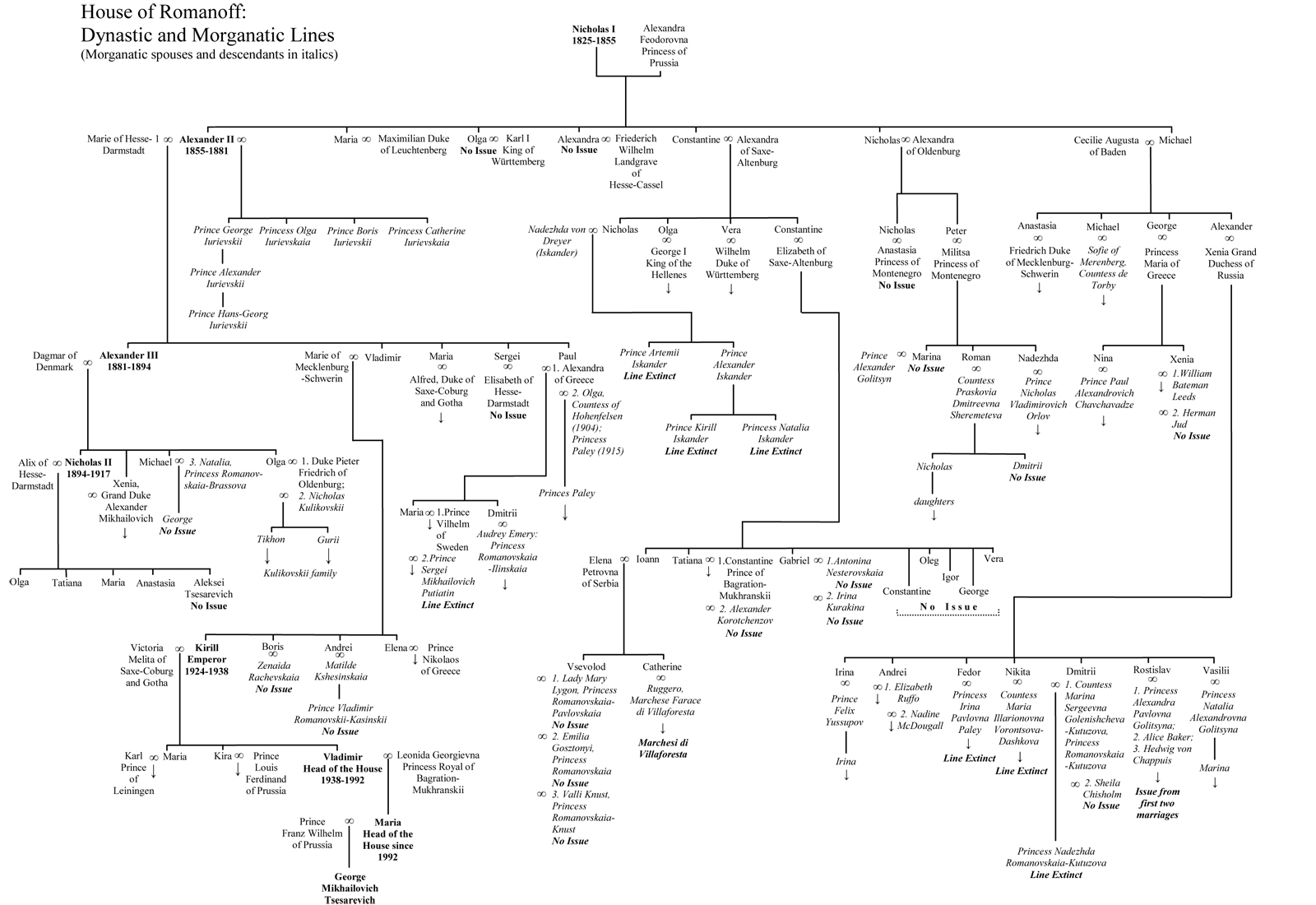
Who Would Be Tsar of Russia Today? | Romanov Family Tree
The Orthodox prophecies are that the throne will be restored via the female line, from the nation that gave Russia the faith, which is Greece. That is Xenia and her successors. Only the Russian Orthodox Church Outside of Russia and its successor True Orthodox Churches are legitimate, not the "Russian Orthodox Church" you cite.
Of course, they will have a husband, in all probability and be, as True Orthodox Christians, bound to obey them. The name of the ruler, the Tsar, will be a name that has been of a Patriarch, or Metropolitan who was head of the true Russian Orthodox Church, but not of a previous Tsar. George has been widely suggested. But, there´s at least one other, Adrian. They will have to be True Orthodox Christian and fervent in the faith. I am a direct descendant of the pre-Conquest English Royal Family and am True Orthodox and not currently married. I´m available and qualify! Constantinople is prophecised, widely to be restored on Sunday 9 April 2034. I will be 68 if still around at that time. Some members of my family have shown a natural lifespan of up to 110 years on the male side.
(For this claim see especially from 10:37-11:40 in the video above
Comentários
Enviar um comentário